
The Complete Guide to AI Cameras with 24/7 Full Color Imaging and Cloud Storage

With the rise of AI cameras, physical security is undergoing a fundamental transformation. For decades, traditional closed-circuit television (CCTV) systems operated as passive digital eyewitnesses. They recorded low-resolution, grainy, black-and-white footage that property owners only reviewed after a break-in, theft, or breach had already occurred.
Today, passive recording is obsolete. Modern surveillance has shifted toward proactive threat deterrence and intelligent real-time awareness.
At the center of this evolution is the powerful combination of an AI camera equipped with a full color Camera sensor and integrated cloud storage CCTV camera ecosystem. These advancements allow property owners, ranging from homeowners protecting their families to enterprise managers securing massive logistics hubs to detect, verify, and stop threats before they escalate.
1. The Core Architecture of Modern AI Cameras Surveillance
To understand why an AI camera with 24/7 full-color capabilities outperforms traditional security setups, we must look at the hardware and software driving the technology.
Deep Learning and Edge AI Processing
Traditional motion sensors rely on simple pixel-change detection. A blowing tree branch, a passing cat, heavy rain, or headlights flashing across a driveway would trigger false alarms, flooding property owners with hundreds of useless notifications every day.
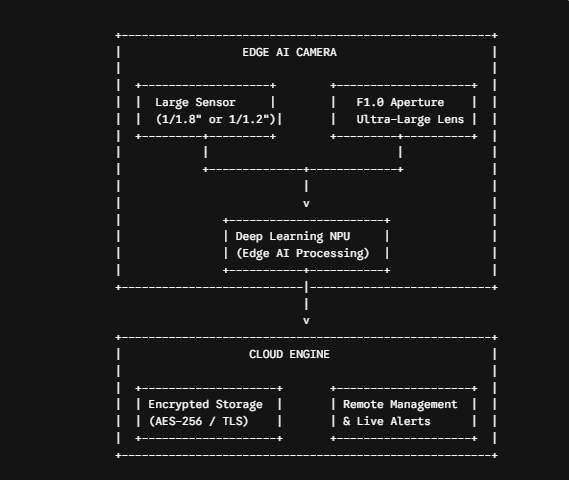
An AI camera replaces old motion sensing with Neural Processing Units (NPUs) running advanced deep learning algorithms. Processed locally directly on the “edge” (the camera itself), these algorithms evaluate video feeds in milliseconds. They classify targets into specific categories:
- Humans: Identifying bipedal movement, posture, and spatial positioning.
- Vehicles: Distinguishing cars, trucks, motorcycles, and bicycles while filtering out shadows.
- Behavioral Patterns: Detecting loitering, perimeter crossing, line crossing, and object abandonment.
By filtering out environmental noise, an edge-based AI camera reduces false alarms by up to 90%, ensuring that when an alert lands on your phone, it represents a real, actionable security event.
The Physics of 24/7 Full-Color Night Vision
Traditional infrared (IR) night vision relies on IR LEDs that flood an area with invisible light. While functional, IR produces monochrome images that lack essential details like clothing color, hair color, or vehicle paint shades, vital evidence required by law enforcement.
A true 24/7 full color Camera uses a hardware-driven approach to capture vivid, full-spectrum video even in near-total darkness:
- Ultra-Large Lenses (Super Aperture): Utilizing $f/1.0$ or $f/1.2$ apertures, these lenses collect up to 400% more ambient light than standard $f/2.0$ security lenses.
- Advanced Low-Light Sensors: High-sensitivity image sensors (such as 1/1.8″ or 1/1.2″ Starlight and ColorVu class sensors) capture microscopic amounts of light from street lamps, stars, or distant lighting.
- Smart Supplemental Lighting: For zero-lux environments (pitch darkness), smart cameras utilize warm, non-blinding LED lights. These lights only activate when motion is confirmed, preserving dark skies while illuminating targets in full color.
2. The Cloud Storage Revolution in AI Cameras Systems
Hardware is only half the equation; how video data is processed, saved, and accessed dictates the long-term reliability of a security system.
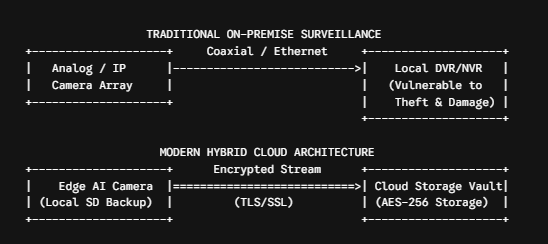
Historically, CCTV setups relied exclusively on physical Digital Video Recorders (DVRs) or Network Video Recorders (NVRs) stored in a utility closet. However, physical recorders present inherent vulnerabilities: intruders can steal or smash the NVR, destroying all evidence of their crime.
Why Cloud Storage is Essential
Deploying a cloud storage CCTV camera mitigates physical vulnerabilities by securely transmitting video streams directly to off-site cloud servers via end-to-end encryption (TLS/SSL).
- Tamper-Proof Evidence: Even if an intruder damages or destroys an outdoor camera, every second of footage up to the point of destruction is already safely preserved in the cloud.
- Seamless Accessibility: Cloud platforms allow users to log in through web portals or mobile apps from anywhere worldwide to view live feeds, download clips, or share video with authorities.
- Intelligent Cloud Search: Coupled with AI metadata, a cloud storage CCTV camera system lets users search thousands of hours of recorded footage using natural queries, such as “show all red vehicles between 2:00 AM and 4:00 AM”—saving hours of manual review.
- Hybrid Storage Redundancy: Premium deployments combine local storage (high-capacity MicroSD cards or localized NVRs) with cloud backups. If the local internet drops, the camera saves footage locally and syncs it to the cloud once connectivity resumes.
3. Commercial & Industrial Security Applications by AI Cameras
Security needs vary dramatically across different property types. Industrial and commercial environments demand high-durability hardware, wide coverage zones, and robust central control systems.
Warehouses and Industrial Logistics
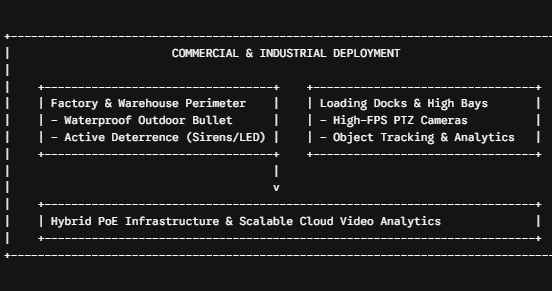
A dedicated CCTV camera for factory and warehouse operations must solve complex challenges: wide expanses, high ceilings, poor internal lighting, heavy machinery traffic, and valuable inventory stock.
- Perimeter Defense: Industrial facilities require a waterproof outdoor bullet camera rated at IP67 or higher to withstand harsh weather, industrial dust, and physical impacts. Bullet cameras feature long-range lenses capable of monitoring fence lines up to 200 feet away.
- Operational Monitoring: Inside logistics hubs, AI-driven cameras monitor fork-truck safety zones, track pallet placement, and verify cargo handling at loading docks.
- Loss Prevention: Combining full-color night vision with cloud backup ensures that overnight shifts, off-hour deliveries, and yard movements are captured with color-accurate clarity, protecting against internal loss and external trespassing.
4. Residential Home Security: Protecting Families and Property
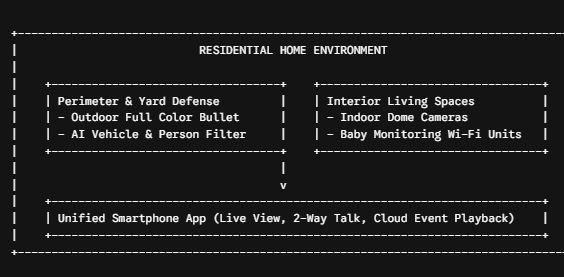
Residential properties require non-intrusive, reliable, and aesthetically integrated security solutions. Whether protecting an urban apartment or a suburban estate, a modern home security CCTV camera network provides continuous coverage inside and outside the residence.
Perimeter Protection with Outdoor Bullet AI Cameras
For driveways, backyards, and side alleys, an outdoor home security CCTV camera acts as the primary barrier against intruders.
- Installing a waterproof outdoor bullet camera equipped with AI threat detection lets homeowners create customized “virtual tripwires” around property borders.
- If an intruder steps past a property boundary at midnight, the camera instantly activates its warm supplemental LEDs, turning night into day, and flashes red/blue deterrence lights while pushing a video alert to the owner’s phone.
Discreet Indoor Protection
Inside the home, aesthetic integration and privacy are paramount.
- An indoor dome camera for home use provides a sleek, low-profile footprint mounted flush against ceilings or walls. Dome housings protect the lens from tampering while blending cleanly into modern interior aesthetics.
- For nurseries and playrooms, a dedicated baby monitoring WiFi camera provides high-value functionality. Unlike traditional audio monitors, an AI-powered smart baby monitor includes cry detection, thermal surface monitoring, pan-tilt motorized lenses, and two-way audio, allowing parents to calm infants remotely while streaming secure 1080p or 4K video.
5. Deployment Options: Wireless vs. Hardwired PoE Systems AI Cameras
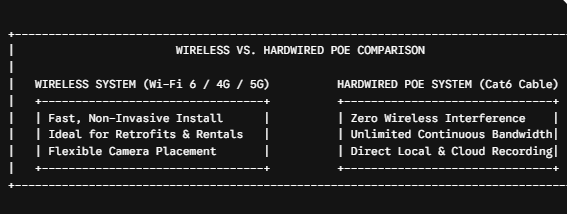
When selecting hardware, property owners must weigh the trade-offs between a flexible wireless security camera system and a hardwired Power over Ethernet (PoE) architecture.
Wireless Security Camera Systems
A modern wireless security camera system utilizes Wi-Fi 6 or cellular connectivity (4G/5G SIM) to transmit video streams to local receivers and cloud platforms.
- Pros: Rapid, non-invasive installation with minimal wiring required; ideal for historic properties, rented spaces, or locations where running Ethernet cables is cost-prohibitive.
- Cons: Vulnerable to dense wall signal attenuation or Wi-Fi network congestion if insufficient bandwidth is allocated.
Power over Ethernet (PoE) Hardwired Systems
PoE setups utilize a single Cat5e/Cat6 network cable to deliver both high-speed data transmission and electric power directly to each camera.
- Pros: Flawless transmission stability, immunity to radio interference, support for ultra-high bitrates (uncompressed 4K/8K video streams), and centralized battery backup (UPS) integration at the network switch.
- Cons: Requires physical cabling runs through attic spaces, conduit, or drop ceilings during deployment.
6. Financial Analysis and Purchasing Strategy: Understanding CCTV Price Dynamics
Navigating the market requires a comprehensive understanding of the factors driving CCTV price variations. Equipment costs depend directly on sensor sizing, lens aperture quality, AI processing capabilities, build ratings, and cloud storage subscription terms.
Hardware and Service Cost Structure
| System Tier | Typical Equipment Included | Core Capabilities | Expected Price Range (USD) |
| Entry Level (Basic Residential) | 2–4 Wi-Fi Cameras, MicroSD cards, standard IR night vision | Motion detection, 1080p video, basic app notifications | $100 – $300 |
| Mid-Tier (Smart Residential / Small Business) | 4–8 AI-powered cameras, 24/7 full-color night vision, Hybrid Cloud/NVR | AI person/vehicle filtering, $f/1.0$ lenses, 2K/4K resolution, cloud backup | $400 – $1,200 |
| Enterprise / Industrial Tier | 8–32+ IP PoE Cameras, Thermal/PTZ Bullets, Redundant Cloud Engine | Active deterrence, license plate recognition (LPR), IP67 metal housings, central management | $1,500 – $5,00 |
Total Cost of Ownership (TCO) Considerations
When evaluating overall value, look beyond initial hardware sticker prices:
- Cloud Subscriptions: Cloud storage services typically charge a low monthly or annual fee per camera based on video retention windows (e.g., 7-day, 30-day, or 60-day continuous or event-based recording).
- Bandwidth Savings: Cameras featuring advanced H.265+ video compression algorithms reduce file sizes by up to 70% without sacrificing visual quality, minimizing cloud storage tiers and internet data consumption.
- Professional Installation Value: While DIY options exist for simple indoor setups, hiring a professional CCTV camera installation service guarantees proper camera placement, concealed weather-sealed wiring, optimized network configuration, and long-term service warranties.
7. Selecting and Deploying Your Surveillance Network AI Cameras
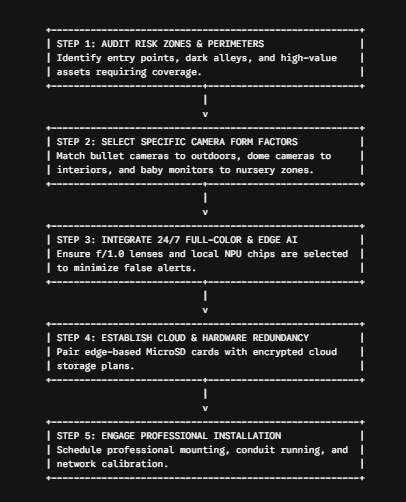
To achieve total property protection, follow this step-by-step framework to configure your security layout:
Step 1: Audit Risk Zones
Map out all critical entry paths, driveway channels, dark property corners, and indoor common spaces. Ensure outdoor cameras face high-traffic approaches to maximize line-of-sight identification.
Step 2: Choose Form Factors Appropriately
- Deploy a high-grade waterproof outdoor bullet camera along long outer walls, fence lines, and driveways where high visibility deters potential trespassers.
- Position an indoor dome camera for home hallways, entry foyers, or commercial reception desks to maintain discreet monitoring.
- Place a portable baby monitoring WiFi camera on dedicated nursery shelves or wall mounts for clear overhead views of cribs and play spaces.
Step 3: Mandate AI Filtering and Low-Light Capabilities
Verify that every outdoor camera includes $f/1.0$ or $f/1.2$ wide-aperture optics, high-sensitivity sensors, and deep-learning edge AI. This guarantees that night feeds remain clear and vibrant 24 hours a day.
Step 4: Configure Cloud Storage and Connectivity
Select a cloud storage CCTV camera subscription that provides at least 30 days of event recording backed by end-to-end encryption. Ensure your local home or business network provides sufficient upload bandwidth to stream video feeds cleanly.
Step 5: Professional Installation & System Calibration
Rely on an experienced CCTV camera installation service to complete physical mountings, run protected cabling through walls, adjust lens focus angles, configure motion detection tripwires, and pair all equipment with your mobile app platform. Professional calibration ensures zero blind spots and long-term operational reliability.
Final Thoughts: The Intelligent Security Standard (AI Cameras)
The security landscape has fundamentally shifted. By replacing passive black-and-white recording with an AI camera backed by a 24/7 full color camera engine and secure cloud storage CCTV camera backups, you establish a proactive shield around your home or enterprise.
Whether you need a simple baby monitoring WiFi camera, an indoor dome camera for home safety, a heavy-duty waterproof outdoor bullet camera, or a site-wide CCTV camera for factory and warehouse protection, investing in modern edge AI technology delivers unmatched peace of mind, crystal-clear color evidence, and continuous real-time protection.
| Feature / Metric | Hikvision | Dahua | Axis Communications | EZVIZ |
| Primary Target Market | Commercial, Enterprise & SMB | Commercial, Enterprise & Residential | High-Security Enterprise & Critical Infrastructure | Residential, DIY & Small Business |
| Full-Color Tech Brand | ColorVu Technology | Full-Color / TiOC (Three-in-One) | Lightfinder 2.0 | Color Night Vision |
| Night Vision Mechanism | $f/1.0$ super-aperture lens, Starlight sensors & warm supplemental LEDs | $f/1.0$ optics, dual illumination (IR + warm white light trigger) | Extreme low-light RGB sensors + high-level noise reduction processing | Dual warm spotlights + IR hybrid switching upon motion detection |
| AI Capabilities | AcuSense & DeepinView: Human/vehicle classification, facial recognition | WizSense & WizMind: Tripwire, vehicle/person filtering, perimeter defense | ARTPEC Deep Learning Processing: Edge object analytics & behavioral profiling | On-Device AI: Human shape detection, pet tracking, auto-tracking |
| Cloud Storage Options | Hik-Connect / Enterprise Cloud Services | Dahua Cloud / DoLynk Care Platforms | Axis Camera Station Cloud / Hybrid VMS Integration | EZVIZ CloudPlay Subscription Platform |
| Price Point | Mid-Range to High | Mid-Range to High | Enterprise / Premium | Budget to Mid-Range |
Brand-by-Brand Deep Dive
1. Hikvision
- Full-Color Night Vision: Powered by ColorVu, Hikvision relies on $f/1.0$ super-aperture lenses that let in 4 times more ambient light than conventional security lenses. In zero-light environments, soft warm LED illuminators activate to maintain vivid 24/7 full-color video without overexposing targets.
- AI Integration: AcuSense technology runs deep-learning algorithms at the camera edge, reducing false alarms by up to 90% by ignoring rain, leaves, and animals to focus strictly on human and vehicle targets.
- Cloud Storage: Managed through Hik-Connect. It supports hybrid cloud architectures, allowing local NVR/SD card recording backed up by encrypted cloud video events.
2. Dahua
- Full-Color Night Vision: Dahua’s Full-Color and TiOC (Three-in-One Camera) lines utilize large CMOS sensors and warm light illuminators. The TiOC series uses smart dual illumination: it stays in discrete IR night vision mode until AI detects a threat, instantly switching on warm white lights to record full-color evidence while flashing active-deterrence sirens and strobe lights.
- AI Integration: WizSense and enterprise-tier WizMind deliver precise perimeter protection, quick target search, license plate recognition (LPR), and heat-mapping.
- Cloud Storage: Integrated via Dahua Cloud and DoLynk Care, allowing flexible cloud event recording alongside local micro-SD backup.
3. Axis Communications
- Full-Color Night Vision: Axis takes an optical approach with Lightfinder 2.0. Rather than flooding an area with intense visible LEDs, Lightfinder captures true-color images in near-total darkness using ultra-high-sensitivity sensors and custom image signal processors.
- AI Integration: Powered by the proprietary ARTPEC chip with Deep Learning (DLPU). Axis Object Analytics (AOA) accurately detects, classifies, and tracks humans and vehicles with low latency directly on the device.
- Cloud Storage: Axis integrates with enterprise Virtual Management Systems (VMS) through Axis Camera Station and hybrid cloud partners. It emphasizes strict cybersecurity protocols (Axis Edge Vault) and encrypted off-site cloud retention.
4. EZVIZ
- Full-Color Night Vision: Designed for residential users, EZVIZ cameras feature Smart Color Night Vision. Units typically operate in black-and-white IR mode until the camera detects human movement, automatically triggering twin spotlights to capture full-color footage.
- AI Integration: Built-in AI models handle Human Shape Detection, vehicle detection, motion tracking (pan-tilt models), and crying baby detection without needing an external NVR.
- Cloud Storage: Relies heavily on EZVIZ CloudPlay. It offers consumer-friendly subscription plans for continuous or event-triggered cloud recording, backed by AES 128-bit encryption alongside MicroSD storage (up to 512GB).
Which Brand Should You Choose?
- Choose Hikvision or Dahua if: You are looking for high-performance $f/1.0$ hardware, active deterrence lighting, and high-value AI capabilities for residential, commercial, or warehouse setups.
- Choose Axis if: You need high-end enterprise security, forensic-grade image clarity, robust hardware cybersecurity, and open-platform integration for critical infrastructure or corporate facilities.
- Choose EZVIZ if: You want a simple, DIY plug-and-play Wi-Fi camera system with hassle-free cloud video app subscriptions for home protection.
Compare specific camera models between Hikvision ColorVu and Dahua TiOC in terms of price, resolution, and specs.
| Feature / Specification | Hikvision ColorVu (Smart Hybrid / Live Guard) (Model: DS-2CD2387G3-LIS2UY/SL) | Dahua TiOC 2.0 / 3.0 (Model: DH-IPC-HDW3849H-AS-PV) |
| Max Resolution | 8MP / 4K ($3840 \times 2160$ @ 20/25 fps) | 8MP / 4K ($3840 \times 2160$ @ 25/30 fps) |
| Image Sensor & Aperture | 1/1.2″ Large Sensor, $f/1.0$ Super Aperture Lens | 1/2.8″ Starlight CMOS Sensor, $f/1.0$ Aperture Lens |
| Night Vision Mode | ColorVu 3.0 + Smart Hybrid Light: Stays in IR or ambient full-color; switches to warm white LEDs upon target detection. | Smart Dual Illuminators: Stays in IR mode and switches to warm white light when AI detects a human/vehicle. |
| Active Deterrence | White flashing strobe light & customizable voice warning/siren. | Red & Blue “police-style” flashing lights and a customizable siren. |
| AI Analytics | AcuSense 3.0: AI human and vehicle classification, tripwire, and intrusion detection. | WizSense AI: Smart Motion Detection (SMD 4.0), perimeter protection, human/vehicle identification. |
| Audio | Two-way audio (Built-in mic + speaker) | Two-way audio with dual-mic noise reduction |
| Ingress Protection | IP67 Weatherproof rating | IP67 Weatherproof rating |
| Typical Price Range | $160 – $220 USD (Slight premium tier) | $130 – $180 USD (High value / budget-friendly) |
(Note: Equivalent 4MP versions include DS-2CD2047G2-LU for Hikvision and DH-IPC-HDW3449H-AS-PV for Dahua, priced roughly $30–$50 lower per unit).
Key Takeaways & Feature Differences
1. Low-Light Performance (ColorVu Edge)
- Hikvision ColorVu: Utilizes larger 1/1.2″ image sensors in its premium models, making it the gold standard for pure optical low-light imaging. It captures ambient light in near-total darkness with minimal light noise.
- Dahua TiOC: Delivers impressive color clarity using Starlight sensors but relies slightly more on its warm supplemental LEDs in pitch-black environments.
2. Active Deterrence & Intruder Warning
- Dahua TiOC: Stands out with its high-visibility red and blue police-style flashing lights and loud siren, making it an aggressive, proactive deterrent for outdoor perimeters.
- Hikvision: Uses a bright white strobe/flashing light combined with voice prompts or custom audio warnings.
3. Pricing & Ecosystem
- Dahua TiOC: Typically provides 10%–20% lower hardware costs for comparable 4MP or 8MP resolution and AI feature sets.
- Hikvision ColorVu: Commands a slight price premium due to its advanced optical sensor chipsets and imaging performance.
Which Should You Choose?
- Go with Hikvision ColorVu if: your priority is obtaining the absolute highest optical low-light image quality with minimal reliance on white spotlights.
- Go with Dahua TiOC if: You want maximum active deterrence (red/blue lights + loud sirens) to scare off trespassers at a more competitive price point.
What are the average monthly cloud storage subscription costs for EZVIZ CloudPlay vs Hikvision Hik-Connect?
| Feature | EZVIZ CloudPlay | Hikvision Hik-Connect |
| Sales Channel | Direct in-app purchase (Credit Card/App Store) | Purchased in-app or via authorized installers/distributors |
| Multi-Camera Savings | Excellent (Home Plan covers up to 4 cameras under one fee) | Subscriptions are bound per camera/channel |
| Best For | Residential DIY users with 2 to 4 cameras | Commercial setups or professional PoE installations requiring installer support |
Artificial intelligence Cameras (FAQs)
Here are 10 of the most frequently asked questions regarding AI CCTV cameras, covering technology, capabilities, setup, and practical use cases.
1. What makes an AI camera different from a traditional CCTV camera?
Traditional CCTV cameras are passive recorders that rely on basic pixel-change motion detection, which often triggers false alarms from swaying trees, shadows, or passing animals. AI CCTV cameras use deep-learning neural processing units (NPUs) to actively analyze video feeds in real time. They classify targets (such as humans, vehicles, or animals), detect specific behaviors (loitering, line crossing), and trigger proactive alerts rather than just recording footage.
2. How does an AI camera eliminate false motion alerts?
By utilizing edge-based object classification algorithms, an AI camera evaluates spatial shape, movement trajectories, and visual characteristics. It filters out non-threatening environmental triggers—like rain, wind-blown foliage, insects, or lighting changes—and only sends notifications when a confirmed human or vehicle breaches a defined area, reducing false alarms by up to 90%.
3. What are Virtual Tripwires and Intrusion Detection Zones?
Virtual tripwires and intrusion zones are AI analytics features that allow you to draw digital boundaries over a camera’s field of view in a mobile app or VMS:
- Virtual Tripwire: Triggers an alert when an object crosses a drawn line in a specific direction (e.g., entering a private driveway).
- Intrusion Zone: Triggers an alert when a person or vehicle enters and remains inside a designated multi-point polygon zone for a set duration.
4. How does “Smart Search” work when reviewing recorded footage?
Instead of manually watching hours of timeline footage, Smart Search relies on AI metadata tags. You can filter recorded video by target type (e.g., “Show all red vehicles between 1:00 AM and 4:00 AM”) or search by specific boundary triggers. This turns hours of playback review into a 10-second search.
5. Can AI cameras capture full-color video in total darkness?
Yes. AI cameras equipped with 24/7 full-color technology (such as Hikvision ColorVu or Dahua Full-Color) combine $f/1.0$ super-aperture lenses, high-sensitivity low-light sensors, and smart supplemental lighting. When the AI detects human or vehicle activity at night, it activates soft warm LEDs or white spotlights to capture vivid color evidence instead of grainy black-and-white infrared images.
6. Do AI cameras require an active internet connection to run analytics?
No. Most modern AI cameras perform Edge AI processing locally on the camera’s internal chipset or an on-premise NVR/AI Box. Features like human/vehicle classification, line crossing, and localized sirens function 24/7 without internet access. Internet connectivity is only required for remote mobile notifications, live streaming, or cloud backup.
7. What advanced object detection features can AI cameras perform?
Depending on hardware grade and software integration, AI cameras can handle:
- Automatic Number Plate Recognition (ANPR / LPR)
- Facial Recognition & White/Blacklist Alerts
- PPE & Safety Compliance (detecting hardhats or safety vests in industrial sites)
- Unattended Object & Missing Item Detection
- Fire, Smoke, & Thermal Anomaly Detection
8. Is cloud storage mandatory for AI CCTV cameras?
Cloud storage is optional but recommended for security redundancy. AI cameras can store video locally on high-capacity MicroSD cards or local NVR hard drives. However, cloud storage protects video evidence against physical theft or destruction of the camera/recorder, ensuring recorded events are preserved off-site.
9. Can I upgrade my existing CCTV system to AI without replacing all my cameras?
Yes. You can add AI functionality to existing IP or analog camera systems by installing an AI NVR / DVR or an Edge AI Box. These centralized processing hubs receive standard RTSP video feeds from existing cameras and apply real-time AI analytics at the recorder level.
10. How do AI CCTV systems protect user privacy and comply with regulations?
Reputable AI CCTV manufacturers adhere to privacy standards such as GDPR, CCPA, and NDAA compliance through:
- Automatic Face & License Plate Blurring on live feeds or exported clips.
- End-to-End Data Encryption (AES-256 for storage and TLS/SSL for transmission).
- Role-based access controls ensuring only authorized personnel view or export AI video analytics.